
Mock Dates
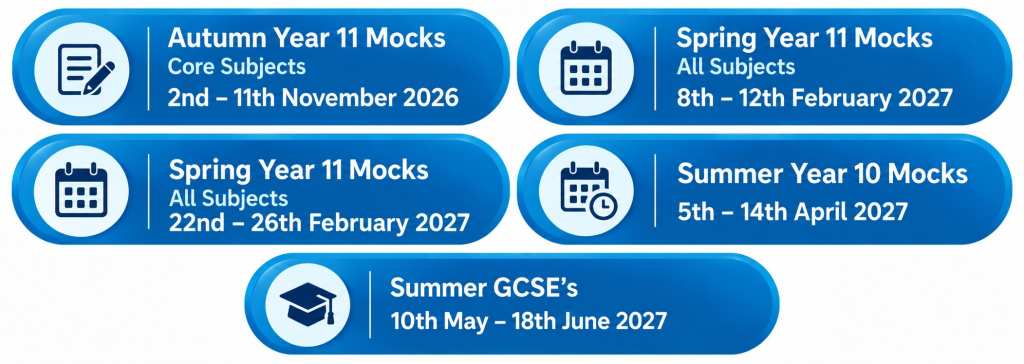
Mock examinations play a vital role in preparing students for their final assessments. All subjects will be examined, and every paper will take place in the hall to replicate real exam conditions.
The half-term break between the two mock weeks offers an additional opportunity for students to consolidate their learning and experience authentic exam expectations. These assessments help pupils identify their current performance level, pinpoint gaps in knowledge, and understand how to improve.
They also provide a valuable period for effective revision, reducing the need for last-minute cramming. Furthermore, mocks enable teachers to assess students’ strengths and weaknesses, allowing them to deliver targeted support and guidance.
Summer 2027 Exams
Exam period:10th May – 18th June 2027
Results day: Thursday 19th August 2027
- Some non-exam assessments, like modern foreign language speaking tests, may be scheduled before the main exam period.
- Specific exam timetables will be provided to every student – including seat number and concessions information.
- You must be available for exams throughout the entire period, from the first exam until the last day.
For full GCSE Timetable please click here: GCSE Timetable 2027 – Orchard Mead Academy | TMET Leicester MAT
Preparing for Success: Learning to Learn at KS4
At KS4, we run weekly assemblies focused on exam preparation, wellbeing, and effective revision strategies. Central to this is our Learning to Learn module, which equips students with practical tools to maximise their learning and revision.
What the Learning to Learn Module Covers
- Understanding How Memory Works – Students learn how information moves from working memory to long-term memory and why thinking hard about knowledge is essential for retention.
- Creating an Effective Study Environment – Guidance on choosing quiet, distraction-free spaces and organising resources to optimise focus.
- Planning Revision – Techniques such as the Pomodoro method to structure study sessions with regular breaks, reducing fatigue and improving productivity.
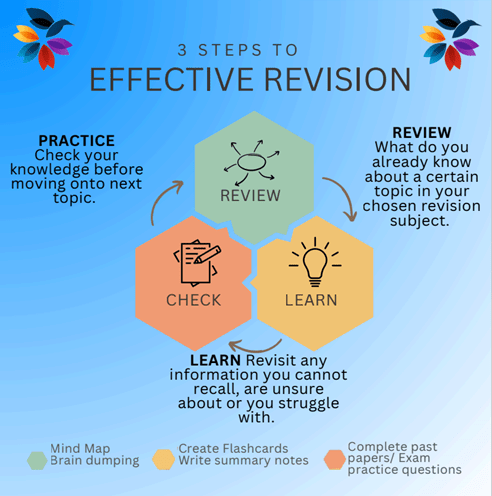
- Active Revision Strategies – Pupils are taught high-impact methods like self-quizzing, flashcards, knowledge dumps, and exam practice to strengthen recall and confidence.
- Prioritising Weak Areas – Students learn how to identify topics they find most challenging and focus their efforts effectively.
By following these strategies, pupils develop strong revision habits, reduce stress, and feel confident heading into exams.
Three Step Model For revision
Top Tips for effective Revision
Start Early – Begin revising well before exams to allow time for repeated practice and avoid last-minute cramming.
Think Hard About What You Learn – Engage actively with the material; simply re-reading notes is not enough.
Create a Distraction-Free Environment – Work in a quiet, tidy space without phones or social media.
Use Active Revision Methods – Self-quizzing, flashcards, knowledge dumps, and exam practice are highly effective.
Plan Your Revision – Use structured methods like the Pomodoro Technique (25 minutes work, 5 minutes break).
Prioritise Weak Areas – Focus on topics you find most challenging rather than revising what you already know well.
Avoid Distractions – Remove phones and unnecessary devices from your workspace to maintain concentration.
Take Regular Breaks – Short breaks help maintain focus and prevent fatigue.
Resources
Centre-policy Orchard Mead
IFC – NE Assessments
IFC – Coursework Assessments
IFC – Written Examinations
IFC – On-Screen Examinations
Information for Candidates Privacy
DFE Student Guide
Exams Behaviour Policy Nov 20-21
JCQ Social Media Information for Candidates
Information for candidates – Coursework Assessment
Information for candidates – Non-Examination Assessments
Exam Policies
Candidate Identification process 26 27
Complaints Policy for exams 26 27
Conflict of Interest Policy for Exams updated Feb 26
Emergency Evacuations Policy 26 27
Escalation Policy 26 27
Exam Contingency and appendix 1 26 27
Internal Appeals for Access Arrangement and Special Consideration 26 27
Non examinations assessment policy 26 27
Suspected Malpractice Policy updated 26 27
Word Processor Policy 26 27
Awarding Body Privacy Notices
Student Privacy Notice | AQA
Candidate Privacy Policy
Privacy Policy | Pearson qualifications
Wjec Privacy Notice
 Together We Can Make a Positive Difference