
SEND report 2026-27
Introduction and Essential Contacts
This report tells parents and carers how Orchard Mead Academy helps students with Special Educational Needs and Disabilities (SEND). At our school, we believe that “Together we make a positive difference”. We want everyone to achieve their best and feel safe. This report helps you understand the support your child can get.
| What is the Age Range of pupils at Orchard Mead Academy | 11 to 16 years | |
| Special Educational Needs Coordinator (SENDCo) | Natalie Clarke | |
| Academy Councillor with responsibility for SEND | Jay Virk | |
| Contact Information | ||
| Email (SENDCo) | [email protected] | |
| Local Offer Webpage Link | Click here for Leicester Local Offer | |
The following sections explain what SEND is and how we find students who need help.
What is SEND and What Needs Do We Support?
Children learn in different ways. Some children find learning harder than others of the same age. These children may need extra help to succeed in school.
There is a law called the Code of Practice. It says a child has SEND if they need extra help that other students do not need. This help is “additional to or different from” what other students get.
We support students in four main areas:
- Communication and Interaction: This is for students who find it hard to talk to others or understand social rules. This includes things like speech delay or Autism.
- Cognition and Learning: This is for students who learn at a slower pace. This includes things like Specific Learning difficulties (SpLD) – Dyslexia (reading and writing) or Dyscalculia (maths).
- Social, Emotional and Mental Health: This is for students who feel very anxious or sad. This includes things like ADHD, depression, or needing support with feelings.
- Sensory and Physical Needs: This is for students with disabilities that make it hard to use a normal classroom. This includes things like hearing loss, vision loss, or physical disabilities.
The school works hard to find these needs early so we can help right away. We also know that some students have needs in more than one area.
How We Identify and Assess Students with SEND
It is very important to find out early if a student needs help. When we find a need early, support can start quickly. This helps the student stay on track.
We find out who needs help by:
- Checking records from primary school and previous KS2 results.
- Using various standardised tests when students first join the academy.
- Using progress data from their learning at Orchard Mead.
- Using literacy tests to check reading and writing skills.
- Listening to concerns from teachers, parents, or the students themselves.
We use this information and data to support our students. Our teachers are trained to change and adapt their lessons to match what your child needs. Once we find a need, we follow a set plan to help.
Families also receive termly reports regarding a student’s academic achievements, homework and attitude to learning. These are based on class teacher assessments and work within lessons. These will also be used by the SEND team to inform provision and support.
The Graduated Approach: How We Help Your Child
The school uses a step-by-step way to give support. This support grows or changes based on how well the student is doing.
School support for children and young people with SEND | LCC Family Hub
We follow these four stages:
- Assess: We look at your child’s needs, speaking with your child, with teachers and listening to your views.
- Plan: We choose the best help for your child.
- Do: We put the help in place in the classroom, or an appropriate intervention may be offered.
- Review: We check if the help is working and talk to you and your child about it.
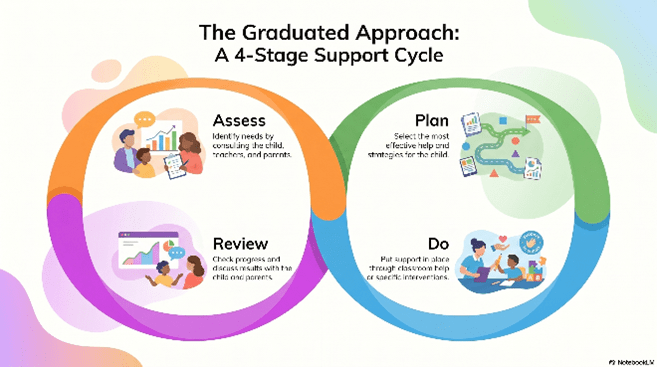
When a child has been through this cycle, once, twice, or more and we still feel a student needs a lot of extra help, we may add their name to our SEND Register. We will always ask for your permission before we do this.
Teaching and Adapting the Curriculum
We believe in Quality First Teaching. This means teachers teach well and are responsive so that every student can join in the lesson. Adults within the school are highly trained and specific training across the four areas of need are provided, so that they can support students in the best ways.
We use Adaptive Teaching. This means teachers change the way they teach to enable students to progress. We also follow Best Endeavours, Reasonable Adjustment (BERA) process when suitable.
Some of the ways we adapt within school include:
- Using iPads, interactive whiteboards, and visualisers in class.
- Using Satchell One so you can see homework easily at home.
- Having accessible toilets and a medical room for insulin testing or injections. This information can be found on the school accessibility plan: TMET-Accessibility-Plan-v3.0.pdf.
- Offering homework clubs after school to help with learning.
Funding for SEND (Element 3 and Top-Up Funding)
Schools have their own budgets for SEND. However, some students have very high needs that cost more. In these cases, the school can ask the Local Authority for extra money to support students.
This extra money is called Element 3 or Top-Up Funding. The school applies for this in such cases. The school needs to show what support the school has already tried and what support may be needed.
Watch: What is Top-Up Funding?
The Local Authority decides how much money to give. This money is then used to support the student. If a student needs long-term help, we may request a statutory assessment by the Local Authority, as a student may need an Education, Health, and Care Plan (EHCP).
Education, Health, and Care Plans (EHCP)
An EHCP is a legal plan for students who need considerably more help than other students.
Helpful Videos:
- What is an education, health and care plan?? | LCC Family Hub
- Request an education, health and care plan needs assessment | LCC Family Hub
- Statutory assessment process | LCC Family Hub
The process to get an EHCP takes 20 weeks:
- Request: You or the school ask the Local Authority (LA) for an assessment of need (Statutory Assessment).
- Week 6: The Local Authority (LA) decides if they will look at the student’s needs.
- Week 12: A panel reviews reports from different experts.
- Week 16: The Local Authority (LA) decides if they will give the student a plan.
- Week 20: The final EHCP is finished.
After this process, the SENCO will meet with you and discuss how the EHCP will be put in place within the school and how they will meet the needs of your child.
Every year, we hold an Annual Review to check the plan and update your child’s goals.
Watch: What is an Annual Review?
If you disagree with a decision the Local Authority (LA) makes about an EHCP, you have rights.
Watch: How to Challenge Decisions
You can ask for Mediation to talk things through. You also have the right to go to a SEND Tribunal.
Specialist Provision
Some students do better in smaller groups or with special units. Orchard Mead Academy has a Designated Specialist Provision (DSP).
A DSP is a specialist unit inside our school. Students in the DSP spend time in the unit but also join in mainstream classes. Orchard Mead has a DSP for Communication and Interaction. A place in the DSP is only given if it is named in a child’s EHCP.
Outside Agencies
If we feel you child needs extra support from outside agencies we may consider a referral to the following services:
- School Nurse and GP
- Speech and Language Therapy
- Educational Psychology
- Social Care
- CAMHS (Mental Health Support) – via the GP
- Educational Welfare Officers
Working with Parents and Students
We believe that working together is the best way to help. You are the expert on your child.
If your child is on the SEND register, we meet/talk with parents three times a year. This includes Parents’ Evenings. We also listen to students to hear their views. We put these views in a Pupil Profile. This helps all teachers know how to support your child.
If you need independent advice, you can contact SENDIASS:
- Website: http://www.sendiassleicester.org.uk/
- Phone: 0116 2575027
Moving On: Transitions and Adulthood
Change can be hard for students with SEND. We plan to make moves easier.
- Primary to Secondary: We visit primary schools and hold extra induction days. We can use photo books of the new school to help students feel ready.
- Year 9 and Above: Annual Reviews focus on “Preparing for Adulthood.” We talk about what the student wants for their future.
Preparing for adulthood | LCC Family Hub
- Secondary to College: We work with colleges and services like Connexions to plan the move.
Handling Complaints and Challenging Decisions
We want to solve any worries quickly. If you are unhappy with your child’s support, please follow these steps:
- Talk to the SENDCo: Please talk to the SENDCo first. Most problems can be solved this way.
- Formal Complaint: If you are still unhappy, use the school’s formal Complaints Procedure. You can find this in the “Policies” section of our website.
We are here to work with you. Together, we will make sure your child has the support they need to succeed.
 Together We Can Make a Positive Difference